


 +86-731-89578196
 [email protected]


- Home
- Our Company
-
Products
Sputtering Targets
- Industries
- Blog
- FAQ
- Contact Us
Aluminum Sputtering Targets: Properties, Grades, and Performance in Thin-Film Coating
Introduction — Why Aluminum Is a Core Material in Modern Thin-Film Technology
Aluminum is one of the most widely used materials in thin-film coating because it combines several key advantages: it’s lightweight, highly conductive, and forms a naturally stable oxide layer. These features make aluminum sputtering targets a go-to choice for applications like semiconductors, display panels, solar cells, and reflective coatings.
As thin-film technologies continue to evolve, the demands on materials are getting higher. Manufacturers now expect cleaner films, better conductivity, stronger adhesion, and more uniform layers. This puts a spotlight on the quality and purity of the sputtering targets used in production. Today, high-purity aluminum and specially engineered aluminum alloys are essential for meeting those performance goals.
The growing demand isn’t just about volume—it’s also about precision. Engineers often require customized materials like Al-Si, Al-Cu, or Al-Nd to meet the specific needs of different devices and systems. That’s why understanding how aluminum targets are made, what purity levels mean, and how different grades behave during coating is more important than ever.
In this guide, we’ll break down the key properties of aluminum sputtering targets, compare common purity levels and alloy options, and explain how these choices affect thin-film performance. We’ll also walk through the manufacturing process and give practical tips on how to select the right target for your application.
What Is an Aluminum Sputtering Target?
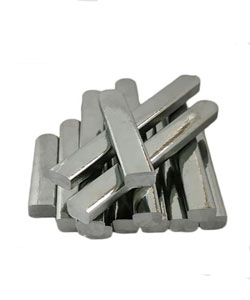
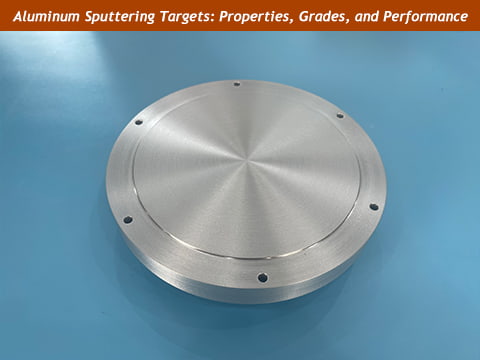
An aluminum sputtering target is a solid piece of high-purity aluminum—or an aluminum-based alloy—used as the material source in PVD (Physical Vapor Deposition) systems. During sputtering, energized ions hit the surface of the target, causing aluminum atoms to be ejected. These atoms then settle onto a substrate, forming a thin, even coating. This process is widely used when manufacturers need precise, repeatable, and high-quality thin films.
Aluminum targets are available in different shapes and formats to match various sputtering systems. The two most common types are:
- Planar targets – flat discs or rectangles, typically used in standard magnetron sputtering systems
- Rotatable targets – cylindrical tubes designed for large-area or high-throughput coating systems
Each format is chosen based on the application, film size, and coating system design.
Aluminum is favored as a target material because it delivers good conductivity, strong reflectivity, and stable adhesion across a wide range of substrates. That’s why it’s commonly used in industries like semiconductors, displays, solar panels, optics, and protective coatings.
In many cases, the success of the thin-film layer depends directly on the quality of the sputtering target. Factors like purity, density, grain structure, and bonding quality all impact how evenly the target erodes and how clean the resulting film will be. For this reason, high-performance aluminum targets are made under strict quality control and often customized to meet specific coating requirements.
Key Properties of Aluminum Sputtering Targets
|
Property Category |
Key Property |
Typical Value / Verified Data |
Why It Matters for Thin-Film Coating |
|
Physical |
Theoretical Density |
2.70 g/cm³ |
Higher final density indicates fewer voids and more stable sputtering. |
|
Electrical Resistivity |
~2.65 μΩ·cm at 20°C |
Low resistivity supports conductive films used in IC, displays, and PV cells. |
|
|
Thermal Conductivity |
~237 W/m·K |
Dissipates heat efficiently during sputtering, preventing localized overheating. |
|
|
Coefficient of Thermal Expansion (CTE) |
~23.1 × 10⁻⁶ /K |
Important for bonding stability and preventing thermal stress cracks. |
|
|
Melting Point |
660.3°C |
Determines heat tolerance during high-power sputtering. |
|
|
Chemical |
Purity Levels |
3N (99.9%), 4N (99.99%), 5N (99.999%) |
Higher purity produces cleaner films with fewer impurities and defects. |
|
Oxidation Behavior |
Forms stable Al₂O₃ layer |
Proper oxide control ensures clean sputtering and predictable erosion. |
|
|
Mechanical / Structural |
Grain Size |
20–200 μm typical (fine-grain processed) |
Smaller grains improve sputtering uniformity and reduce particle generation. |
|
Bonding Options |
Type of Bond |
Indium Bonding (common) |
Common Aluminum Alloy Sputtering Targets and Their Uses
While high-purity aluminum is widely used for general thin-film coatings, aluminum alloys offer added benefits when specific performance improvements are needed—such as better thermal stability, higher mechanical strength, or enhanced conductivity. Below are four commonly used aluminum alloy sputtering targets, each designed for specialized applications in semiconductors, displays, MEMS, and advanced electronics.
Aluminum-Copper (Al-Cu)
Typical Composition: 0.5–10% Cu
Why It’s Used:
- Improves electromigration resistance, helping metal lines last longer under electrical stress
- Enhances corrosion resistance, especially useful in high-humidity environments
- Offers stronger adhesion to certain substrates than pure aluminum
Applications:
Widely used in semiconductor metallization, IC interconnects, and high-reliability electronic components where long-term stability is critical.
Aluminum-Neodymium (Al-Nd)
Typical Composition: 0.5–2% Nd
Why It’s Used:
- Greatly improves thermal stability, keeping films stable during high-temperature steps
- Helps maintain a fine-grain structure, reducing film defects after annealing
- Increases adhesion strength, lowering the risk of peeling in large-area coatings
Applications:
Popular in display manufacturing, including TFT-LCD and OLED panels, especially for gate electrode layers that must stay stable during thermal processing.
Aluminum-Scandium (Al-Sc)
Typical Composition: 0.3–2% Sc (customizable)
Why It’s Used:
- Boosts film strength and mechanical durability
- Enhances piezoelectric properties, useful in acoustic and MEMS devices
- Produces dense, smooth films with better corrosion resistance
Applications:
Used in RF filters, SAW/BAW devices, MEMS sensors, and next-gen communication systems that need reliable, high-performance coatings.
Aluminum-Silicon-Copper (Al-Si-Cu)
Typical Composition: ~0.5–2% Si, 0.5–5% Cu
Why It’s Used:
- Silicon improves thermal stability and helps prevent junction damage
- Copper improves conductivity and resistance to electromigration
- The combination delivers a balanced film with good electrical, thermal, and mechanical performance
Applications:
Common in advanced semiconductor interconnects, especially in chips that undergo repeated heating and cooling cycles or require long-term reliability.
Why Choose Alloyed Aluminum Targets?
Engineers often choose alloyed aluminum when thin films must perform under tougher conditions—such as high temperatures, high current loads, or repeated stress. These targets offer:
- Better film stability and adhesion
- Improved corrosion resistance
- Tunable electrical or mechanical properties
- Greater reliability over time
When pure aluminum isn’t enough, alloyed targets offer the flexibility and performance needed for more demanding applications.
Performance of Aluminum Targets in Thin-Film Coating
Aluminum sputtering targets are known for producing films that are clean, consistent, and easy to control. Their performance directly impacts film quality in terms of conductivity, reflectivity, adhesion, and stability—making them a reliable choice for high-precision applications across electronics, optics, and solar technologies.
Here’s how aluminum targets perform in real-world coating environments:
Stable and Clean Sputtering
High-purity aluminum targets offer steady erosion rates and low contamination levels. Their excellent thermal conductivity helps spread heat evenly across the target, reducing the risk of hot spots, arcing, or plasma instability during deposition. This results in smooth, consistent coating runs, even in high-volume or long-cycle production.
Excellent Electrical Conductivity
Aluminum films have naturally low resistivity (~2.65 μΩ·cm), which makes them ideal for conductive layers in:
- Semiconductor interconnects
- Touchscreens and display electrodes
- Solar cell contacts
- RF components
Using a high-purity target ensures that the film maintains its electrical performance without unwanted impurities.
High Reflectivity and Optical Performance
Aluminum reflects both visible and infrared light very well. This makes it a top choice for applications where brightness, reflectivity, or optical efficiency matter—such as:
- Optical mirrors
- Display backplanes
- Solar panel reflectors
- Lighting systems
Consistent sputtering helps produce smooth, uniform reflective films with minimal surface defects.
Good Adhesion and Smooth Surface Quality
With proper system tuning and surface prep, aluminum films offer strong adhesion and form even, fine-grain surfaces. This is especially important for layered coatings, where peeling or delamination can affect device performance. Finer grain structures in the target reduce particle generation, helping improve film yield and surface smoothness.
Low Internal Stress and Reliable Long-Term Stability
Compared to harder metals, aluminum tends to form films with lower internal stress, reducing the risk of cracking, curling, or warping. This is particularly important in devices exposed to thermal cycling or mechanical stress over time.
Why It Matters
The film you get from an aluminum sputtering target is only as good as the material and manufacturing behind it. Targets with the right purity, grain structure, and bonding quality allow you to achieve:
- Higher yield
- Better process repeatability
- Fewer film defects
- Longer equipment uptime
That’s why aluminum remains one of the most widely used and trusted sputtering materials for thin-film production.
Applications of Aluminum Thin Films
Aluminum thin films are used across many industries because they combine strong electrical performance, high reflectivity, and stable deposition behavior. These films play essential roles in semiconductor devices, display technologies, photovoltaic modules, and optical systems. Below are the major application areas where aluminum coatings are commonly used today.
Applications of Aluminum Thin Films
Aluminum thin films are used across a wide range of industries because they combine good conductivity, high reflectivity, and stable adhesion. These films play important roles in everything from semiconductor devices and display panels to solar modules and optical systems. Below are the most common applications where aluminum coatings are essential.
Semiconductors and IC Metallization
Aluminum is widely used as a conductive layer in semiconductor devices. Its low resistivity and easy deposition make it a standard material for:
- Interconnects and wiring layers
- Bonding pads
- Power lines in ICs
In advanced processes, aluminum is often alloyed or paired with other materials (like Ti or Cu) to improve adhesion and resist electromigration.
Display Panels and Touch Sensors
In display manufacturing, aluminum films are applied as electrodes, gate lines, and reflective layers in technologies such as:
- TFT-LCD
- OLED
- Touchscreens
Aluminum offers strong conductivity and excellent reflectivity, while aluminum alloys like Al-Nd or Al-Si improve film stability during high-temperature processing.
Photovoltaics (Solar Cells)
Aluminum coatings are used in solar modules to:
- Reflect sunlight back into the active layers
- Form electrical contacts
- Act as back-side coatings for thin-film solar panels
Their high reflectivity and low-cost deposition make aluminum a practical choice for improving energy efficiency.
Optical and Reflective Coatings
Due to its ability to reflect visible and infrared light, aluminum is a popular choice for:
- Optical mirrors and filters
- Telescope and imaging systems
- Lighting reflectors
It forms smooth, bright coatings with consistent optical performance, making it ideal for both precision optics and general-purpose reflective films.
Automotive, Aerospace, and Architectural Uses
In industrial and commercial applications, aluminum films are valued for their lightweight, corrosion resistance, and appearance. Common uses include:
- Thermal barrier coatings
- Decorative metallic layers
- Anti-corrosion layers for lightweight structures
These films are often applied through PVD methods to achieve better durability and film control compared to traditional coatings.
Why Aluminum Is So Widely Used
Whether the goal is electrical performance, optical reflection, or protective layering, aluminum thin films offer a cost-effective and reliable solution. Their versatility—combined with stable sputtering behavior and wide availability—makes aluminum one of the most widely used materials in thin-film engineering.
How to Choose the Right Aluminum Sputtering Target
Choosing the right aluminum sputtering target is essential for achieving consistent deposition, clean film quality, and stable production performance. The ideal target depends on your technical requirements, system configuration, and the level of reliability needed for your application. Below is a clearer, more structured guide to help you evaluate the key factors.
Purity Level: 4N, 5N, or Higher?
Purity directly affects the electrical behavior, optical quality, and defect rate of the deposited film. Even small impurity differences can influence performance in sensitive devices.
- 99.99% (4N): Suitable for general coatings, reflective layers, and standard display applications.
- 99.999% (5N): Preferred for cleaner, lower-resistivity films in advanced electronics.
- 99.9995% (5N5): Recommended for semiconductor, optical, and ultra-low-defect processes.
Higher purity results in fewer contaminants, improved process stability, and better long-term device reliability.
Pure Aluminum vs. Aluminum Alloys
Not all aluminum films behave the same. Alloying allows the deposited film to take on specialized properties.
- Al-Si: Improved thermal stability and reduced junction spiking—common in semiconductor wiring.
- Al-Cu: Enhanced resistance to electromigration, ideal for interconnects carrying current.
- Al-Nd: Maintains grain stability during annealing, widely used in TFT display electrodes.
- Al-Sc: Higher mechanical strength and excellent acoustic performance for MEMS and RF devices.
Choose pure aluminum when conductivity and reflectivity are the top priorities; choose alloys when the device requires enhanced reliability or specific functional performance.
Bonded vs. Unbonded Targets
For most planar targets, bonding is essential to manage heat and prevent mechanical failure.
- Indium bonding ensures outstanding thermal conductivity and is the industry standard.
- Elastomer bonding adds flexibility and stress absorption for long sputter runs or rapid cycling.
- Unbonded targets are typically used for low-power research or prototype systems.
A well-bonded target minimizes the risk of cracking, delamination, or overheating.
Target Shape and System Compatibility
The target must match your sputtering system's source design and cooling structure:
- Planar discs or rectangular plates for standard magnetron sputtering systems.
- Rotatable targets for high-throughput, large-area deposition such as in display manufacturing.
- Custom geometries for specialized chambers or research applications.
Dimensions, bolt patterns, backing plate configurations, and cooling interfaces must be carefully matched to avoid installation issues.
Common Problems and How to Avoid Them
Many thin-film problems trace back to poor target quality:
- Arcing or unstable plasma: Often caused by voids, uneven grains, or improper bonding.
- Particle contamination: Caused by coarse grains or micro-cracks in the target body.
- Film non-uniformity: Linked to density variation or inconsistent microstructure.
- Target cracking: Result of inadequate bonding or heat dissipation.
Choosing a well-produced, fully inspected target greatly reduces these risks.
Summary
The ideal aluminum sputtering target provides the right balance of purity, microstructure, alloy composition, and bonding quality. By selecting a target tailored to your application—whether for semiconductors, displays, PV modules, or optical coatings—you ensure stable sputtering performance and dependable thin-film results.
Conclusion
Aluminum sputtering targets are a trusted choice for making thin films in many industries. They’re used in semiconductors, displays, solar panels, and optical products because they’re easy to work with and deliver stable, high-quality results.
The key to getting good performance is choosing the right target. Higher purity levels like 99.99% or 99.999% help create cleaner, more reliable coatings. In some cases, aluminum alloys—such as Al-Si, Al-Cu, Al-Nd, or Al-Sc—are better if the film needs to be stronger, more stable, or have special properties. Other factors like grain size, density, and bonding also affect how smoothly the sputtering process runs and how good the final film looks.
By selecting the right type of aluminum target for your application, you can improve coating quality, reduce defects, and make your production process more efficient. As thin-film technologies continue to grow, aluminum will remain one of the most important materials in the field.