


 +86-731-89578196
 [email protected]


- Home
- Our Company
-
Products
Sputtering Targets
- Industries
- Blog
- FAQ
- Contact Us
Metal 3D Printing Powder: Materials, Properties, and How to Choose
views, Updated: 2026-11-25
Introduction
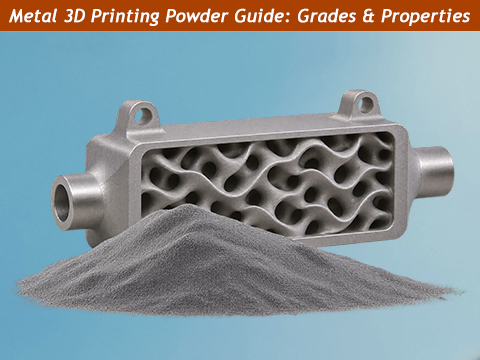
Metal 3D printing powder is made up of small metal or alloy particles used to build parts layer by layer. It allows manufacturers to produce complex shapes, such as mold inserts with internal cooling channels, that can be difficult to machine.Two powders of the same alloy grade can behave differently in the same printer. Particle size and shape affect how evenly the powder spreads or how steadily it feeds into the machine. That’s why industrial buyers need to check both the alloy grade and the powder specifications before placing an order.
This guide explains which metals are commonly used, which powder properties matter, and how to choose a powder that meets the requirements of your printer and finished part.
How Is Metal Powder Used in 3D Printing?
The printing process determines how metal powder reaches the area being built. In powder bed fusion, the machine spreads a thin layer of powder before a laser or electron beam melts selected areas. In powder-fed directed energy deposition, a nozzle delivers powder directly to the area being built.Laser Powder Bed Fusion (LPBF)
A spreading blade or roller lays down a thin layer of metal powder. A laser scans the cross-section of the part and melts the powder along that path. The metal cools and joins the layer below. The machine spreads a fresh layer of powder, and the cycle repeats until the part is complete. This process is also commonly called selective laser melting (SLM).Electron Beam Powder Bed Fusion (EB-PBF)
Also known as electron beam melting (EBM), this process uses an electron beam to melt selected areas of a powder layer inside a vacuum chamber. The machine typically preheats the powder bed before melting each layer. EB-PBF often uses coarser powder than LPBF, so buyers should check the particle size range specified for their machine and alloy.Powder-Fed Directed Energy Deposition (DED)
In laser-based DED, a laser creates a small pool of molten metal on the surface of a part. A nozzle feeds powder into this pool, where it melts and bonds to the surface as it cools. The nozzle and laser move along a programmed path to build up material. Laser Engineered Net Shaping (LENS) is one example. Manufacturers can use this process to repair worn areas or add features to an existing component.For powder bed fusion, the powder needs to spread into even layers. For powder-fed DED, it needs to pass through the feed system at a steady rate. These are different requirements to check when purchasing powder for a specific machine.
Common Metal 3D Printing Powders and Their Applications
Start with what the finished part needs to do. A lightweight bracket, a mold insert, and a heat exchanger each place different demands on the material. The table below compares common metal 3D printing powders by grade and application.| Material family | Common grades | Why choose it? | Typical applications |
|---|---|---|---|
| Titanium alloys | Ti-6Al-4V | High strength for its weight and good corrosion resistance | Aerospace brackets and orthopedic implants |
| Aluminum alloys | AlSi10Mg, AlSi12 | Low weight and good heat transfer | Lightweight housings and heat sinks |
| Stainless steels | 316L | Good corrosion resistance | Industrial fittings and fluid-handling parts |
| Tooling steels | 18Ni300 maraging steel | High strength and hardness after heat treatment | Mold inserts with internal cooling channels |
| Nickel-based alloys | Alloy 625, Alloy 718 | Alloy 625 is often selected for corrosion resistance, while Alloy 718 is valued for strength at elevated temperatures | Chemical processing components and high-temperature machinery parts |
| Cobalt-chromium alloys | CoCrMo | Good wear and corrosion resistance | Dental frameworks and orthopedic components |
| Copper and copper alloys | Pure copper, CuCrZr | Pure copper offers high conductivity, while CuCrZr offers a balance of conductivity and strength | Heat exchangers, cooling plates, and electrical components |
Some applications can use more than one material. For a cooling plate, AlSi10Mg may be suitable when low weight is a priority. Copper or CuCrZr may be a better fit when heat transfer is the main requirement. Once you have a shortlist, check which grades your machine and printing process are qualified to run.
Which Powder Properties Affect 3D Printing Performance?
Once you’ve selected an alloy, check how the powder will behave in your machine. Particle size and shape affect how the powder spreads or feeds, while chemistry and contamination limits help determine whether the powder meets your material specification.Particle Size and Size Distribution
A powder’s nominal size range describes the size fraction being supplied. For example, 15–53 µm is used in some laser powder bed fusion (LPBF) systems, while 53–105 µm is used in some electron beam powder bed fusion (EB-PBF) systems. The required range depends on the machine, alloy, and qualified printing process.The range alone gives you limited information about how the particles are distributed. For a volume-based measurement, these three values give a clearer picture:
· D10 is the size below which 10% of the powder volume falls.
· D50 is the median particle size by volume.
· D90 is the size below which 90% of the powder volume falls.
Two lots can have the same nominal size range but different D10, D50, and D90 values. A lot with more fine particles may be more prone to clumping, which can make it harder to spread evenly.
Particle Shape, Flowability, and Apparent Density
Round particles generally flow more readily than irregular ones. Small particles attached to larger ones, often called satellites, and clusters of particles can also affect how smoothly the powder moves.Flowability describes how readily powder moves under a given test condition. In practice, a powder bed system needs a uniform layer, while a powder-fed system needs a steady supply through the nozzle.
Apparent density is the mass of loose powder per unit volume, including the spaces between particles. It tells you how much powder occupies a given volume before printing. The density of the finished part is measured separately.
Alloy Chemistry, Oxygen Content, and Inclusions
Check the measured chemistry against the limits for the specific grade. For titanium alloys such as Ti-6Al-4V, oxygen is especially important because it can affect the finished part’s ductility. Use the oxygen limit specified for your grade and process when reviewing the powder lot.Also check any requirements for foreign particles, such as ceramic inclusions. These can create local defects in a printed part even when the reported alloy chemistry meets the specified limits.
How Is Metal 3D Printing Powder Made?
Metal 3D printing powder can be made by turning molten metal into small droplets that cool into solid particles. The production method influences particle shape and size. After production, the powder is sorted by size and tested before shipment.Gas Atomization
In gas atomization, a high-speed gas stream breaks molten metal into small droplets. The droplets cool as they fall, forming particles that are generally round.Two variants differ in how they melt the metal before atomization:
· Electrode induction melting gas atomization (EIGA) melts the tip of a metal electrode without using a crucible. This avoids contact with a crucible during melting and is useful for reactive alloys such as titanium.
· Vacuum induction melting gas atomization (VIGA) melts the alloy in a crucible under vacuum before a gas stream breaks up the molten metal. It is used for materials such as stainless steels and nickel-based alloys.
Plasma Rotating Electrode Process (PREP)
In PREP, a plasma heats the tip of a rapidly spinning metal electrode. As the tip melts, the rotation throws off small droplets. They cool into round particles.The choice between PREP and gas atomization depends in part on the size fraction needed. Even when a method produces highly spherical particles, the amount of powder it yields in the required size range can affect availability and cost.
Powder Classification and Lot Testing
The powder comes out of production in a range of sizes. Producers use sieves or other classification equipment to separate it into fractions. They then test each lot against the purchase specification. Depending on the application, those tests may cover particle size distribution, alloy chemistry, oxygen content, flowability, and apparent density.For buyers comparing powders made by different methods, the lot-specific test results show whether each shipment meets the requirements of the intended printing process.
Conclusion
The right metal 3D printing powder matches both the finished part and the printing process. Choose an alloy grade based on how the part will be used, then check whether the powder’s particle size distribution and chemistry meet the requirements of your machine and process.Before placing a production order, ask for a lot-specific Certificate of Analysis (CoA). It gives your team a way to verify that the powder you receive meets the same specification you used to compare suppliers.
Request a quote from AEM Deposition for your metal additive manufacturing project. Share your alloy grade, printing method or machine model, target particle size range, and required quantity so we can review your specification and confirm available powder options.
LATEST NEWS