


 +86-731-89578196
 [email protected]


- Home
- Our Company
-
Products
Sputtering Targets
- Industries
- Blog
- FAQ
- Contact Us
Tantalum Carbide: Properties and Applications in Thin-Film Coatings
views, Updated: 2026-10-14
What Is Tantalum Carbide?
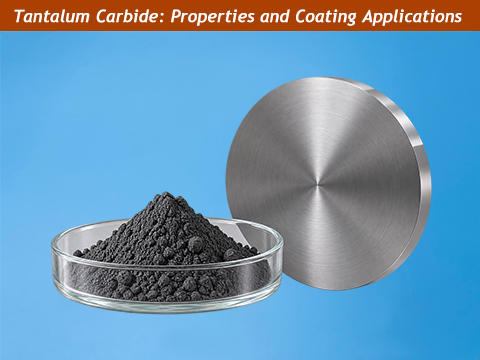
Tantalum carbide (TaC) is a ceramic compound made of tantalum and carbon. It is known for its extremely high melting point, high hardness, and good thermal stability, making it suitable for demanding industrial applications.Because of these properties, tantalum carbide is used in high-temperature components, wear-resistant materials, and specialized protective coatings. In thin-film coating applications, TaC can help improve surface hardness and wear resistance when the coating composition and deposition process are properly controlled.
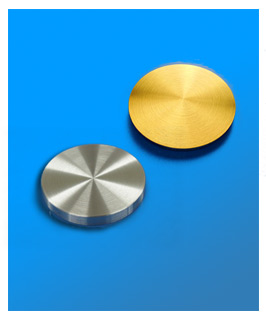
Tantalum carbide is also available in sputtering target form for physical vapor deposition (PVD). During sputtering, material from the target is transferred to a substrate to form a thin film. The resulting film properties depend on factors such as target composition, deposition conditions, and substrate characteristics.
For manufacturers developing coatings for demanding environments, understanding the properties of TaC is an important first step in determining whether it is suitable for a specific application.
Key Properties of Tantalum Carbide
Tantalum carbide (TaC) is known for its high melting point, hardness, and thermal stability. These properties make it useful for applications that require materials to withstand high temperatures and surface wear.High Melting Point and Thermal Stability
Tantalum carbide has a melting point of approximately 3,880°C, making it suitable for many high-temperature applications.Its ability to withstand extreme heat makes it useful in specialized coatings and high-temperature components. However, the performance of a TaC coating also depends on its thickness, composition, and deposition process.
High Hardness and Wear Resistance
Tantalum carbide is a very hard ceramic material. It can help protect surfaces against scratching, abrasion, and wear.This makes TaC a potential choice for protective coatings on components exposed to friction or repeated contact. The final wear resistance depends on the coating quality, adhesion, and substrate material.
Chemical Stability and Oxidation Resistance
Tantalum carbide offers good chemical stability in certain environments. However, it can oxidize at high temperatures in air or oxygen-rich conditions, forming tantalum oxide.Its suitability for high-temperature coatings therefore depends on the operating temperature and surrounding environment. These factors should be considered when choosing TaC for a specific application.
Applications of Tantalum Carbide in Thin-Film Coatings
Tantalum carbide (TaC) is a hard ceramic material with excellent thermal stability. These properties make it a potential candidate for specialized coatings that must withstand wear, high temperatures, or demanding operating conditions.Wear-Resistant Coatings
Tantalum carbide has high hardness, which can help a coating resist scratching, abrasion, and surface wear. This makes TaC worth considering for components exposed to repeated contact or friction.In these applications, coating adhesion and film quality are also important. A hard coating must bond well to the substrate to provide reliable protection during service.
High-Temperature Coatings
TaC has an extremely high melting point, making it attractive for applications involving extreme heat. TaC-based materials are studied for protecting components that need to maintain their properties at high temperatures.However, TaC can oxidize when exposed to hot air. Its performance in high-temperature environments therefore depends on the surrounding atmosphere, coating structure, and operating conditions.
Advanced Industrial Applications
TaC is also investigated for advanced coating systems and high-performance materials. Its combination of hardness and thermal stability makes it relevant to research into protective coatings for demanding industrial environments.The results depend on how the coating is produced. Film composition, thickness, microstructure, and substrate compatibility all influence the final performance.
For manufacturers, TaC should be evaluated against the specific requirements of the application rather than selected based on hardness or melting point alone.
Tantalum Carbide vs. Other Carbide Coating Materials
Tantalum carbide (TaC), tungsten carbide (WC), and titanium carbide (TiC) are hard ceramic materials used in demanding industrial applications. However, they have different properties and are suited to different operating conditions.Understanding these differences can help manufacturers identify the right material for a specific coating application.
Key Differences Between TaC, WC, and TiC
| Property | Tantalum Carbide (TaC) | Tungsten Carbide (WC) | Titanium Carbide (TiC) |
|---|---|---|---|
| Main advantage | Extremely high melting point | High thermal conductivity and wear resistance | High hardness and wear resistance |
| Melting point | Approx. 3,880°C | Approx. 2,870°C | Approx. 3,160°C |
| Typical applications | High-temperature materials and specialized coatings | Cutting tools and wear-resistant components | Hard coatings, cutting tools, and wear-resistant surfaces |
When Should You Consider Each Material?
Tantalum Carbide (TaC)TaC is worth considering when an application requires a very high melting point and thermal stability. It is also used as an additive in cemented carbide materials to help control grain growth and improve certain high-temperature properties. Its suitability for a coating depends on the deposition process and operating environment.
Tungsten Carbide (WC)
WC is widely used in cutting tools and wear-resistant components. Its high hardness and relatively high thermal conductivity make it useful in applications where abrasion resistance and heat transfer are important. WC-based coatings have also been investigated for machining applications.
Titanium Carbide (TiC)
TiC is known for its high hardness and wear resistance. TiC-based coatings are used in tooling and other applications where surface durability is important. They can be deposited using methods such as PVD and CVD, depending on the coating requirements.
Ultimately, no single carbide is best for every application. The right choice depends on the required coating properties, operating temperature, wear conditions, substrate material, and deposition method.
How Is Tantalum Carbide Used in PVD Coating?
Physical vapor deposition (PVD) is a process used to deposit thin films onto a substrate. Tantalum carbide can be supplied in sputtering target form for PVD applications, where the target material is transferred to a substrate to form a thin coating.The Role of TaC Sputtering Targets
In magnetron sputtering, energetic ions bombard the tantalum carbide target inside a vacuum chamber. This releases atoms and other species from the target, which travel toward the substrate and contribute to film formation.The deposited film can be used to modify the surface properties of a component. Depending on the coating composition and deposition conditions, the goal may be to improve hardness, wear resistance, or performance in demanding environments.
Factors Affecting Film Quality
The quality of a TaC coating depends on both the sputtering target and the deposition process. Important factors include:· Target purity:Impurities may affect film composition and coating consistency.
· Target density and uniformity:A consistent target structure helps support stable sputtering.
· Deposition parameters:Power, pressure, substrate temperature, and deposition time influence film growth.
· Substrate preparation:Surface cleanliness and substrate compatibility affect coating adhesion.
The final film does not always have exactly the same composition as the target. Sputtering conditions and the deposition system can affect the composition and structure of the deposited layer.
For manufacturers planning to use TaC in PVD coatings, matching the target specifications to the deposition system and the required film properties is an important step toward achieving consistent results.
What to Consider When Purchasing Tantalum Carbide Sputtering Targets
Before purchasing tantalum carbide (TaC) sputtering targets, confirm the material specifications and mounting requirements of your deposition system. Providing clear requirements helps suppliers quote the right product and reduces the risk of compatibility issues.Purity and Material Specifications
Confirm the required TaC purity and composition based on your application. If you have specific requirements for the tantalum-to-carbon ratio or impurity levels, include them in your inquiry.Target Dimensions and Design
Provide the required target diameter, length, thickness, and any mounting holes or special machining features. Custom dimensions may be available depending on the supplier's manufacturing capabilities.Bonding and Backing Plate
Check whether your sputtering system requires a backing plate. If a bonded target is needed, specify the backing plate material and any equipment-specific requirements.Quality Documentation
Ask about available material inspection reports and certificates of analysis. Depending on your requirements, these may include chemical composition, purity, density, and other relevant inspection results.Before requesting a quotation, prepare your target specifications, required quantity, and application details. This allows the supplier to evaluate your requirements and provide a more accurate quotation.
Conclusion
Tantalum carbide (TaC) offers a combination of high hardness, thermal stability, and an extremely high melting point, making it a potential material for specialized thin-film coatings and demanding industrial applications.For PVD coating projects, choosing the right TaC sputtering target is essential. Purity, composition, dimensions, and compatibility with your deposition system should all match your project requirements.
Looking for a reliable source of tantalum carbide sputtering targets?
We supply sputtering targets for industrial and research applications, with support for custom dimensions and specifications.
Contact our team for a quotation and share your required purity, target size, quantity, and application. We'll help you evaluate a suitable TaC target for your deposition process.
LATEST NEWS