


 +86-731-89578196
 [email protected]


- Home
- Our Company
-
Products
Sputtering Targets
- Industries
- Blog
- FAQ
- Contact Us
Reactive Sputtering: From Metal Targets to Compound Thin Films in PVD Systems
views, Updated: 2026-06-30
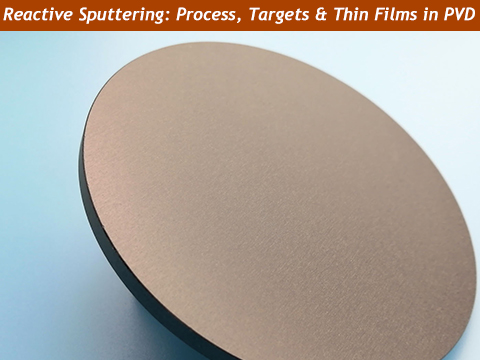
What Is Reactive Sputtering in PVD Deposition?
Reactive sputtering is a thin film coating process used in PVD (Physical Vapor Deposition) systems. It is used to create compound thin films, such as oxides and nitrides, by combining metal atoms with reactive gases during deposition.In a basic sputtering process, a metal target is bombarded by argon (Ar) plasma. This causes atoms from the target to be ejected and deposited onto a substrate, forming a thin metallic film.
Reactive sputtering adds a second step: a reactive gas such as oxygen (O₂) or nitrogen (N₂) is introduced into the chamber. These gases react with the sputtered metal atoms either in the plasma or directly on the substrate surface. As a result, the final film is no longer a pure metal layer, but a compound material.
For example:
· Titanium (Ti) + nitrogen (N₂) → Titanium Nitride (TiN)
· Aluminum (Al) + oxygen (O₂) → Aluminum Oxide (Al₂O₃)
· Zinc (Zn) + oxygen (O₂) → Zinc Oxide (ZnO)
This process is widely used because it allows manufacturers to produce functional coatings directly from simple metal targets, without needing pre-made compound materials.
Reactive sputtering is especially important in industries such as semiconductors, optical coatings, and hard coatings, where film properties like conductivity, hardness, and transparency must be precisely controlled.
Reactive Sputtering Process and Working Principle
Reactive sputtering takes place inside a vacuum chamber, where plasma is used to transfer material from a metal target onto a substrate, while a reactive gas changes the final film composition.The process starts by creating a plasma, usually using argon (Ar) gas. In this plasma, argon ions are accelerated toward the metal target. When they hit the target surface, atoms are physically knocked out (this is called “sputtering”). These metal atoms then travel through the chamber and reach the substrate, forming a thin film.
At the same time, a reactive gas such as oxygen (O₂) or nitrogen (N₂) is introduced into the chamber. These gas molecules react with the sputtered metal atoms during flight or on the substrate surface. This reaction forms a compound thin film instead of a pure metal layer.
A key point in reactive sputtering is that the reaction can also happen on the target surface itself. When this happens, a thin compound layer (oxide or nitride) forms on the target. This is often called target poisoning, and it can change the sputtering behavior and deposition rate.
In practice, the final film formation is influenced by a balance between:
· Physical sputtering (metal atoms ejected from the target)
· Chemical reaction (formation of compounds with reactive gas)
· Transport of atoms through the plasma
· Deposition and growth on the substrate
By adjusting parameters such as gas flow, power, and pressure, engineers can control how much reaction occurs and therefore tune the film properties. For example, a higher oxygen flow will generally produce a more fully oxidized film, while lower flow may result in sub-stoichiometric or mixed compositions.
In industrial production, maintaining this balance is critical. If the reaction is too strong, the process can become unstable; if too weak, the film may not achieve the desired compound structure.
From Metal Targets to Compound Thin Films
Reactive sputtering is powerful because it allows a simple metal target to be transformed directly into a compound thin film on the substrate.In a normal sputtering process, the material on the target and the final deposited film are the same. For example, a copper (Cu) target produces a copper film. However, in reactive sputtering, the situation is different: the metal target is only the starting material, while the final film is formed through chemical reaction in the chamber.
Inside the process, metal atoms are first ejected from the target by argon plasma. These atoms then interact with reactive gases such as oxygen or nitrogen before or after reaching the substrate surface. As a result, a new compound is formed during deposition.
For example:
· Titanium (Ti) target + nitrogen (N₂) → Titanium Nitride (TiN) hard coating
· Aluminum (Al) target + oxygen (O₂) → Aluminum Oxide (Al₂O₃) insulating layer
· Chromium (Cr) target + oxygen (O₂) → Chromium Oxide (Cr₂O₃) protective film
· Zinc (Zn) target + oxygen (O₂) → Zinc Oxide (ZnO) transparent conductive film
One important challenge in this transformation is target surface condition change. As reactive gas interacts with the target, a compound layer can form on its surface. This layer often has different sputtering behavior compared to pure metal, which can affect deposition rate and stability.
This is why reactive sputtering is not just a material process, but also a process control problem. Engineers must carefully manage the balance between:
· Metal sputtering rate
· Reactive gas concentration
· Compound formation speed
When properly controlled, reactive sputtering provides a very efficient way to produce high-quality functional coatings directly from elemental metal targets, without needing pre-made compound materials.
Reactive Sputtering Applications in Industry
Reactive sputtering is widely used in industrial thin film production because it enables direct formation of compound coatings from simple metal targets. It is a key technology in PVD systems for both functional and protective coatings.Semiconductor Thin Film Applications
In semiconductor manufacturing, reactive sputtering is used to deposit insulating and barrier layers that are critical for device performance.Common films include:
· Silicon nitride (Si₃N₄) for insulation and passivation layers
· Silicon oxide (SiO₂) for dielectric and barrier structures
These films help protect circuits, control electrical isolation, and improve device reliability in microelectronics.
Optical Coatings and Display Films
Reactive sputtering is widely used in optical applications where precise control of transparency and refractive index is required.Typical materials include:
· Titanium dioxide (TiO₂) for high refractive index coatings
· Aluminum oxide (Al₂O₃) for anti-reflection and protective layers
These coatings are commonly used in:
· Camera lenses
· Optical filters
· Display panels
· High-performance glass coatings
Transparent Conductive Oxides (TCO) for Electronics
One of the most important industrial uses of reactive sputtering is the production of transparent conductive films.Key materials include:
· ITO (Indium Tin Oxide)
· AZO (Al-doped ZnO)
· IGZO (Indium Gallium Zinc Oxide)
These films combine:
· High electrical conductivity
· High optical transparency
They are widely used in:
· LCD and OLED displays
· Touch panels
· Solar cells
· Flat panel electronics
Hard Coatings and Surface Protection
Reactive sputtering is also used to improve surface hardness, wear resistance, and corrosion resistance in industrial components.Common coatings include:
· Titanium Nitride (TiN)
· Chromium Nitride (CrN)
· Aluminum Titanium Nitride (AlTiN)
Applications include:
· Cutting tools
· Molds and dies
· Automotive components
· Industrial wear parts
Energy and Advanced Functional Applications
In energy-related industries, reactive sputtering is used to develop functional thin films for next-generation technologies.Examples include:
· Thin film layers in solar cells
· Battery electrode coatings
· Functional barrier and catalytic films
These coatings help improve efficiency, stability, and performance in energy conversion and storage systems.
Reactive Sputtering System Design Considerations
Reactive sputtering performance is not only determined by materials and process parameters, but also by the design of the PVD system itself. In industrial production, system configuration plays a key role in ensuring stable deposition, uniform film quality, and scalable manufacturing.A well-designed reactive sputtering system must balance plasma stability, gas control, and target utilization while maintaining consistent film properties over long production cycles.
DC vs RF Reactive Sputtering Systems
Reactive sputtering can be implemented using either DC or RF power sources, depending on the target material and film requirements.· DC sputtering systems are commonly used for conductive metal targets such as Ti, Al, and Cr. They offer higher deposition rates and are widely used in industrial production.
· RF sputtering systems are used for insulating or non-conductive targets and certain complex reactive processes where DC discharge is unstable.
In many industrial applications, DC magnetron sputtering is the preferred choice due to its efficiency and scalability.
Magnetron Configuration and Plasma Control
Magnetron design has a direct impact on plasma density and deposition uniformity.Key design factors include:
· Magnetic field strength and distribution
· Target erosion track design
· Cathode geometry (planar, rotatable, or cylindrical)
· Plasma confinement efficiency
A well-optimized magnetron structure improves target utilization and ensures stable plasma distribution, which is critical for uniform thin film coating.
Gas Delivery and Flow Control System
Reactive sputtering relies heavily on precise gas control. Even small fluctuations in gas composition can significantly affect film quality.Industrial systems typically use:
· Mass Flow Controllers (MFCs) for Ar and reactive gases (O₂, N₂, etc.)
· Multi-zone gas injection to improve uniformity
· Feedback control systems to stabilize reactive gas partial pressure
Accurate gas delivery ensures consistent compound formation and reduces instability caused by target poisoning or process drift.
Process Monitoring and Automation
Modern reactive sputtering systems often integrate real-time monitoring and control technologies to improve stability and repeatability.Common approaches include:
· Optical emission monitoring (plasma state control)
· Partial pressure monitoring in the chamber
· Closed-loop feedback control systems
· Automated recipe control for production consistency
These systems help maintain a stable operating window, especially in high-volume industrial environments where process drift must be minimized.
Scalability for Industrial Production
One of the key challenges in reactive sputtering system design is scaling from laboratory setups to industrial production lines.Industrial systems must ensure:
· Large-area uniform coating capability
· High target utilization efficiency
· Stable long-duration operation
· Compatibility with automated production lines
For semiconductor, display, and optical industries, scalability and repeatability are as important as film performance itself.
Conclusion
Reactive sputtering is a key PVD thin film process that enables the formation of compound coatings such as oxides and nitrides directly from metal targets in a reactive gas environment. It combines physical sputtering and chemical reaction, making it highly flexible for advanced coating applications.Its performance depends on three core factors: stable metal targets, controlled reactive gases, and well-designed PVD systems. When properly controlled, it delivers high-quality functional films for semiconductors, optics, electronics, and protective coatings.
For stable and high-performance thin film production, choosing the right materials is critical. AEM Deposition supports industrial users with high-quality sputtering targets and customized solutions as a reliable sputtering target supplier for semiconductor, optical, and advanced coating applications.
LATEST NEWS