


 +86-731-89578196
 [email protected]


- Home
- Our Company
-
Products
Sputtering Targets
- Industries
- Blog
- FAQ
- Contact Us


Test Wafers Explained: Purpose, Grades, and Applications
views, Updated: 2026-06-16
Introduction
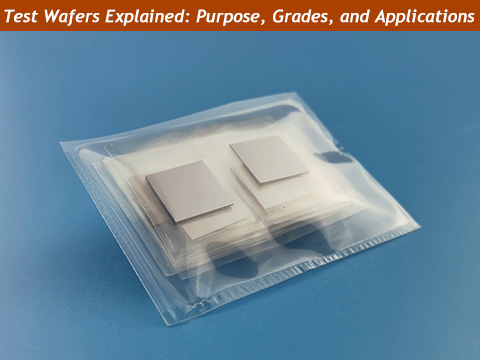
Test wafers are important in semiconductor manufacturing. They help engineers check equipment, test processes, and run experiments before production. Using production-grade wafers for these tasks can be very expensive. Test wafers are a cost-effective alternative.A test wafer is a semiconductor wafer used for equipment testing, process checks, and research. Unlike prime wafers, test wafers may have small surface flaws or minor defects. These imperfections do not affect most non-production tasks. Their lower cost makes them ideal for testing and development work.
Test wafers are used in many processes. These include thin-film deposition, etching, lithography, and chemical mechanical polishing (CMP). They help improve processes, reduce costs, and protect valuable production wafers.
In this article, we will explain what test wafers are, how they differ from other wafer grades, and where they are used in semiconductor manufacturing and research.
What Are Test Wafers?
Definition of a Test Wafer
A test wafer is a semiconductor wafer used for engineering work rather than commercial chip production. It helps engineers evaluate processes, verify results, and prepare manufacturing steps before production begins.Test wafers are available in many of the same materials used for production wafers, including silicon (Si) wafer, silicon carbide (SiC) wafer, gallium nitride (GaN) wafer, and gallium arsenide (GaAs) wafer. They can also be supplied in different wafer sizes, crystal orientations, and doping types to meet specific testing requirements.
Key Characteristics of Test Wafers
The main feature of a test wafer is that it does not need to meet the same quality standards as a prime wafer.A prime wafer is manufactured for high-performance device production and must meet strict specifications for surface quality and crystal structure. Test wafers, on the other hand, may contain minor defects or surface variations that are acceptable for engineering and development work.
Because the quality requirements are less demanding, test wafers are usually more affordable than prime wafers. This allows manufacturers and research teams to perform testing and process development at a lower cost.
Test wafers are available in several formats, including polished, single-side polished (SSP), double-side polished (DSP), patterned, and reclaimed wafers. The best choice depends on the process being tested and the level of accuracy required.
Purpose of Test Wafers
Test wafers help semiconductor manufacturers develop, verify, and improve production processes before they are applied to valuable production wafers. They provide a practical way to test equipment and process conditions while reducing material costs.Process Development and Optimization
Before a manufacturing process is ready for production, engineers must find the right process settings and verify the results. Test wafers are commonly used to evaluate deposition, etching, lithography, and chemical mechanical polishing (CMP) processes.By running trials on test wafers, engineers can adjust process parameters, identify potential issues, and improve process stability without affecting production materials.
Equipment Qualification and Calibration
New equipment must be tested before it is used in manufacturing. Test wafers help engineers confirm that tools are operating correctly and producing consistent results.They are often used during equipment installation, maintenance, and process qualification. This helps reduce production risks and ensures that equipment meets performance requirements before handling production wafers.
Cost Reduction in Research and Development
Research and development often require multiple rounds of testing and experimentation. Using production-grade wafers for every trial can significantly increase project costs.Test wafers provide a more economical option for process evaluation, material studies, and prototype development. This allows research teams to perform more experiments while staying within budget.
As semiconductor technologies continue to advance, test wafers remain an essential tool for accelerating development cycles and reducing overall manufacturing costs.
Grades of Wafers
Semiconductor wafers are categorized into different grades based on their quality, surface defects, and intended use. Understanding these grades helps engineers and manufacturers select the right wafer for each application.Prime Wafers
Prime wafers are the highest quality wafers. They have almost no surface defects and a perfect crystal structure. These wafers are used to make high-performance and high-reliability devices, such as processors, memory chips, and communication ICs. Because of their strict quality requirements, prime wafers are also the most expensive.Test or Research Wafers
Test wafers and research wafers are often grouped together because they serve similar purposes. They are used for process development, equipment testing, and research experiments.- Surface quality: May have minor defects, but still suitable for testing and development.
- Cost: Lower than prime wafers, making them a practical choice for R&D and pilot projects.
- Applications: Engineers use them to optimize processes, test new equipment, and develop prototypes without wasting high-cost prime wafers.
Monitor Wafers
Monitor wafers are mainly used to track and control manufacturing processes. They help engineers monitor production stability, measure process performance, and adjust equipment as needed. Surface defects may exist, but they do not affect their main purpose.Dummy Wafers
Dummy wafers are used for equipment setup, calibration, and process adjustments. They are not intended for making actual devices. These wafers can have more imperfections than test or monitor wafers, but they are essential for preparing production tools and avoiding mistakes on valuable wafers.Reclaim Wafers
Reclaim wafers are used wafers that have been refurbished for further testing or development work. They offer a cost-saving option for non-critical applications while still providing reliable data for process development or training purposes.By knowing the differences between wafer grades, manufacturers and researchers can choose the right wafer for their needs, reduce costs, and ensure accurate process testing.
Common Applications of Test Wafers
Test wafers are used throughout semiconductor manufacturing, research, and equipment development. They allow engineers to evaluate processes and collect data before moving to production-grade materials.Semiconductor Process Development
One of the most common uses of test wafers is process development. Engineers use them to establish process conditions and evaluate results during different manufacturing steps.Typical applications include:
- Thin-film deposition
- Etching processes
- Photolithography
- Chemical mechanical polishing (CMP)
- Surface cleaning and preparation
Equipment Testing and Validation
Test wafers are widely used when installing new equipment or verifying existing tools. They help engineers check whether a machine is operating correctly and producing consistent results.For example, test wafers may be used to:
- Verify deposition uniformity
- Measure etching performance
- Check process repeatability
- Validate tool upgrades and maintenance
Research and Academic Projects
Universities, research institutes, and corporate R&D teams often use test wafers for experimental work. Because they are more affordable than prime wafers, they are well suited for projects that require multiple rounds of testing.Common research applications include:
- New material studies
- Device prototype development
- Process optimization research
- Semiconductor manufacturing education
Training and Demonstration
Test wafers are also valuable for operator training and technical demonstrations. New engineers can learn manufacturing procedures and equipment operation without risking expensive production wafers.In training environments, test wafers provide a practical way to gain hands-on experience while keeping costs under control.
Test Wafers vs. Prime Wafers
Test wafers and prime wafers are both used in the semiconductor industry, but they are designed for different purposes. Understanding their differences can help manufacturers and researchers choose the most suitable wafer for a project.Quality Differences
Prime wafers are manufactured to the highest quality standards. They have very low defect levels, excellent surface quality, and tightly controlled specifications. These characteristics are essential for producing integrated circuits, power devices, and other commercial semiconductor products.Test wafers do not always meet the same strict requirements. They may contain minor surface defects, edge imperfections, or variations that would not be acceptable for production wafers. However, these differences usually do not affect testing, process development, or research activities.
Cost Comparison
Because prime wafers require more inspection and tighter quality control, they are typically more expensive than test wafers.For applications such as equipment testing, process optimization, and engineering evaluation, using prime wafers may increase costs without providing significant benefits. In these situations, test wafers can deliver the required results at a lower cost. This cost advantage is one of the main reasons why test wafers are widely used during research and development stages.
Choosing the Right Wafer
The choice between a test wafer and a prime wafer depends on the application.Prime wafers are usually the best option when the wafer will be used to manufacture semiconductor devices or when the highest material quality is required. Test wafers are often the better choice for process development, equipment qualification, operator training, and laboratory research. They provide a practical balance between performance and cost.
In many cases, engineers begin a project with test wafers and move to prime wafers only after the process has been verified and optimized.
How to Select the Right Test Wafer
Choosing the right test wafer depends on the application, process requirements, and budget. Here are the key factors to consider:Material
Test wafers are available in various semiconductor materials. The most common are:- Silicon (Si): Widely used for general testing and process development.
- Silicon Carbide (SiC): Used for power devices and high-temperature applications.
- Gallium Nitride (GaN) or Gallium Arsenide (GaAs): Used for RF devices and specialized research.
Wafer Size
Test wafers come in different diameters, typically ranging from 2 inches to 12 inches.- Smaller wafers (2–6 inches) are often used for R&D, prototypes, and pilot processes.
- Larger wafers (8–12 inches) are preferred for process optimization on production-equipment scale.
Surface and Polishing
Surface quality affects the accuracy of testing:- Single-side polished (SSP): One side smooth, suitable for basic testing.
- Double-side polished (DSP): Both sides smooth, ideal for processes sensitive to surface defects.
- Patterned or specialized wafers: Used for specific experiments or equipment calibration.
Crystal Orientation and Doping
- Crystal orientation affects deposition, etching, and lithography results. Common orientations are <100> and <111>.
- Doping (n-type or p-type) may be required depending on the process or device being simulated.
Cost Considerations
Test wafers are generally cheaper than prime wafers, but prices vary by material, size, and surface finish. Consider your testing goals to balance quality and cost.By evaluating these factors, engineers and researchers can select the test wafer that best suits their process development, equipment testing, or research project. Choosing the right wafer ensures reliable results and avoids wasting expensive production wafers.
Conclusion
Test wafers may seem simple, but they play a crucial role in the semiconductor world. Beyond cost savings, they act as the “first line of defense” for new processes and equipment. By allowing experiments and process checks on lower-cost wafers, engineers can discover problems early, fine-tune techniques, and avoid costly mistakes on production wafers.In this way, test wafers are not just a tool—they are a key enabler for innovation. They help semiconductor teams move faster, experiment more freely, and bring new devices to market with confidence.
Partner with our team to source high-quality test wafers for silicon, SiC, GaN, and other semiconductor materials. Whether you need wafers for equipment testing, process development, or R&D, we can help you select the right material, size, and specifications to meet your project requirements. Contact us today to discuss your needs and streamline your development process.
LATEST NEWS