


 +86-731-89578196
 [email protected]


- Home
- Our Company
-
Products
Sputtering Targets
- Industries
- Blog
- FAQ
- Contact Us
Indium Tin Oxide (ITO): Key Features, Products, Manufacturing Process, and Applications
views, Updated: 2026-04-22
Introduction
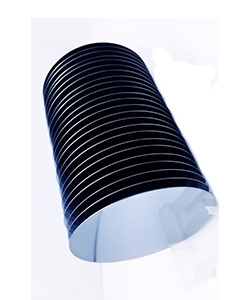
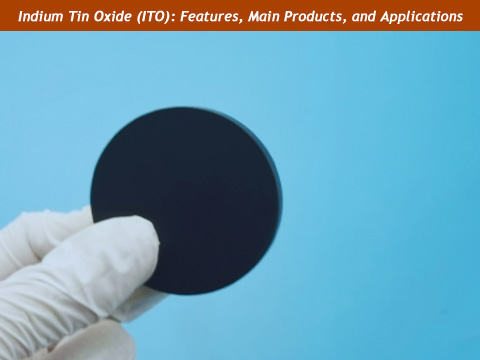
Indium tin oxide (ITO) is a special material that combines transparency with electrical conductivity, making it essential in modern electronics and optical devices. You’ll find ITO in everyday technologies such as touch screens, OLED and LCD displays, solar panels, and smart windows.Because ITO is a ceramic material, it cannot be melted and cast like metals. Instead, it is carefully processed into high-purity sputtering targets or evaporation pellets to create uniform thin films on glass, plastic, or other surfaces. The quality of these ITO materials directly affects the performance of the devices they are used in.
At our company, we specialize in producing high-purity ITO targets and pellets, ensuring consistent conductivity, transparency, and durability. Whether for ITO coatings, thin films, or advanced electronic applications, our products are tailored to meet the strict requirements of modern manufacturing.
What is ITO?
ITO (Indium Tin Oxide) is a semiconductor ceramic material made by combining indium oxide (In₂O₃) and tin oxide (SnO₂) in a precise ratio—usually 90%–95% In₂O₃ and 5%–10% SnO₂. This combination gives ITO its two standout properties: high transparency and good electrical conductivity, which makes it essential for devices that need both optical and electrical performance.ITO thin films allow 85%–95% of visible light (400–700 nm) to pass through while keeping a very low resistivity of 10⁻⁴ to 10⁻³ Ω·cm. This unique balance of transparency and conductivity makes ITO perfect for transparent electrodes in applications such as touchscreens, displays, and solar panels.
Because it is a ceramic, ITO cannot be melted like metals. Instead, it is processed using powder metallurgy, forming high-purity sputtering targets or evaporation pellets. These are then used to deposit uniform, high-quality thin films for advanced electronic and optical devices.
Key Features of ITO
Indium tin oxide (ITO) is widely used in optoelectronic devices because it combines high transparency, excellent electrical conductivity, and strong stability. Its key features include:
1. High Transparency
ITO thin films transmit 85%–95% of visible light (400–700 nm), which is crucial for clear, bright displays and responsive touch panels. Its wide bandgap (3.5–4.3 eV) ensures that visible light is neither absorbed nor reflected, while a refractive index of 1.8–2.0 helps reduce reflection further. High transparency not only maintains image quality and brightness but also improves light absorption in solar cells, enhancing photovoltaic efficiency.
2. Excellent Electrical Properties
ITO is highly conductive due to a combination of high carrier concentration and good electron mobility:
- Carrier concentration: Typically 10¹⁹–10²¹ cm⁻³, contributed by oxygen vacancies and tin doping, providing abundant free electrons for fast device response.
- Electron mobility: Usually 30–40 cm²/V·s, which determines how quickly electrons move under an electric field. Controlling grain size and crystallinity during deposition further improves conductivity.
3. Physical and Chemical Stability
ITO thin films are robust in extreme environments:
- Thermal stability: Remains stable at 200–300°C, making it suitable for high-temperature applications like solar modules and outdoor displays.
- Chemical stability: Resistant to oxidation and mild acidic or alkaline corrosion, enabling long-term reliable performance in industrial and outdoor conditions.
ITO Products
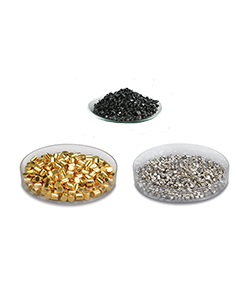
ITO materials are available in forms tailored for different thin-film deposition processes, mainly sputtering targets and evaporation pellets, each suited to specific applications and film requirements.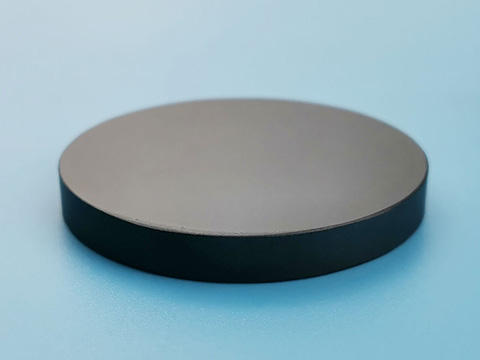
1. ITO Sputtering Targets
Sputtering is the mainstream method for depositing ITO thin films, including DC (direct current) sputtering and RF (radio frequency) sputtering. Key factors for sputtering performance:- Target purity: Directly affects film transparency.
- Deposition rate: Influences film thickness and uniformity.
- Substrate temperature: Higher temperatures improve film crystallinity, enhancing electrical conductivity.
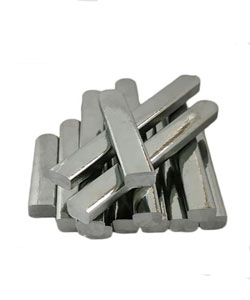
2. ITO Evaporation Pellets
Evaporation methods, including thermal evaporation and electron beam (EB) evaporation, are used to deposit thin, uniform ITO films, commonly in photovoltaic and optical applications.- Thermal evaporation: Material is heated electrically until it vaporizes. Simple and cost-effective, though less precise.
- Electron beam evaporation: Uses an electron beam for heating, offering higher precision and control, but at higher cost.
Key Manufacturing Process for ITO Sputtering Targets
High-quality ITO targets are mainly produced using hot isostatic pressing (HIP). In this process, the ITO powder is heated to high temperatures while being pressed under high pressure. The combination of heat and pressure makes the material dense, uniform, and strong, reducing pores and defects that could affect film quality during sputtering. This step ensures the target can deliver stable, consistent thin films for electronics, displays, and solar applications.
Once the ITO target is sintered, it undergoes precision finishing processes to meet the strict requirements of sputtering deposition:
1. Grinding and Polishing
- The target surfaces are carefully smoothed and leveled.
- A flat, polished surface is crucial because it allows the ITO atoms to deposit evenly on the substrate, resulting in films with consistent thickness, conductivity, and transparency.
- Sintered targets are cut into standard sizes suitable for sputtering equipment.
- Edges are finished carefully to prevent micro-cracks or irregularities, which could lead to uneven deposition or unstable plasma during sputtering.
- Targets are inspected for surface flatness, density, and internal defects.
- Controlling micro-cracks, grain structure, and edge shape helps reduce defects in the deposited thin films, ensuring the final devices perform reliably.
Key Manufacturing Process for ITO Evaporation Pellets
ITO evaporation pellets are made to provide stable, uniform thin films in thermal or electron beam evaporation.
1. Raw Materials
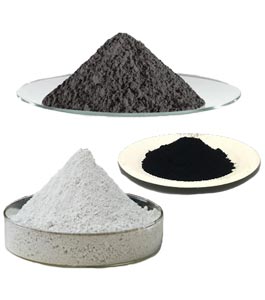
High-purity indium oxide (In₂O₃) and tin oxide (SnO₂) powders, usually 90–95% In₂O₃ and 5–10% SnO₂.
2. Pressing and Sintering
Powders are pressed into pellets and sintered at high temperature to form dense, strong solids. This ensures the pellets evaporate evenly during deposition.
3. Shaping and Finishing
Pellets are cut and polished to precise sizes. Smooth surfaces and defect-free edges help produce consistent thin films with high transparency and conductivity.This process produces ITO pellets that reliably deliver high-quality films for displays, solar cells, and optical coatings.
Applications of ITO
Indium tin oxide (ITO) is widely used across electronics, photovoltaics, smart windows, and emerging technologies because of its unique combination of transparency and conductivity.
1. Display Technology
ITO thin films serve as transparent electrodes in LCDs, OLEDs, and touch panels. Their high transparency ensures bright, clear images, while low resistivity allows fast, precise touch response. These properties make ITO essential for modern high-resolution and high-brightness displays.
2. Solar Photovoltaics
In CIGS and perovskite solar cells, ITO functions as a transparent electrode, conducting current without blocking light absorption. Its combination of excellent conductivity and high light transmittance makes it a critical component in high-efficiency photovoltaic devices.
3. Smart Windows and Energy-Saving Glass
ITO films are used in electrochromic smart windows, allowing control of light transmission via an electric field. This helps regulate indoor brightness and temperature, enabling energy savings in buildings. ITO also supports low-energy glazing, adjusting transparency in response to sunlight.
4. Transparent Conductive Films
Beyond displays and solar cells, ITO coatings are applied in:
- Anti-static coatings – for precision instruments and aerospace windows.
- Electromagnetic shielding – blocking specific frequency ranges.
5. Emerging Applications
- Transparent heating films – used in automotive windshields and aircraft windows to prevent fogging.
- Gas sensors – detecting gases like H₂ and CO by monitoring resistance changes.
- Flexible electronics – despite its brittle nature, ITO is explored on flexible substrates.
- Biosensors – benefiting from ITO’s biocompatibility and conductivity.
- AR/VR devices – enhancing visual experiences through transparent conductive coatings.
Conclusion
Indium tin oxide (ITO) is a key material that combines transparency and conductivity, making it essential for modern electronics. Its high light transmittance, low resistance, and stability make it ideal for touchscreens, displays, solar cells, smart windows, and flexible electronics.Using high-quality ITO sputtering targets and evaporation pellets ensures thin films are uniform, reliable, and perform as expected.
If you need ITO materials for your project, contact us today. We can provide customized sputtering targets and pellets to help you achieve consistent, high-quality thin films for your devices.
LATEST NEWS