


 +86-731-89578196
 [email protected]


- Home
- Our Company
-
Products
Sputtering Targets
- Industries
- Blog
- FAQ
- Contact Us
Optical Coating Materials: Oxide Targets for Thin Film Applications
views, Updated: 2026-08-19
Introduction: The Role of Oxide Materials in Optical Coatings
The performance of an optical coating depends greatly on the materials used. Among various coating materials, oxide materials are widely used due to their excellent transparency, optical stability, and durability. Common materials include SiO₂, TiO₂, Ta₂O₅, Nb₂O₅, HfO₂, and Al₂O₃.
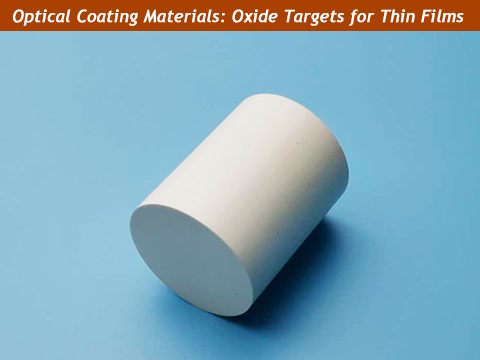
For advanced thin film applications, these oxide materials are often manufactured into sputtering targets and deposited onto substrates using processes such as magnetron sputtering. High-quality oxide sputtering targets help produce uniform, reliable, and high-performance optical coatings.
This article introduces common optical coating materials, the role of oxide sputtering targets, and their applications in thin film manufacturing.
1. Understanding Optical Coating Materials
Optical coating materials are the foundation of thin film coatings. Different materials provide different optical properties, such as controlling light reflection, transmission, and absorption. By selecting the right materials and combining multiple layers, manufacturers can achieve specific optical functions for different applications.Optical coating materials are generally divided into three main categories:
1.1 Metallic Materials
Metallic materials are mainly used for applications that require high reflectivity. Common examples include aluminum (Al), silver (Ag), and gold (Au).These materials are widely used in:
· Reflective mirrors
· Infrared optical components
· Heat-reflective coatings
Metal coatings offer excellent light reflection, but they usually have higher optical absorption compared with dielectric materials. Some metals, such as silver, also require protective layers to improve corrosion resistance.
1.2 Dielectric Materials
Dielectric materials are the most commonly used materials for advanced optical coatings. They are transparent materials with controlled refractive indexes, making them suitable for manipulating light through thin film interference.Common dielectric materials include:
· Silicon dioxide (SiO₂)
· Titanium dioxide (TiO₂)
· Tantalum pentoxide (Ta₂O₅)
· Niobium pentoxide (Nb₂O₅)
· Hafnium oxide (HfO₂)
· Aluminum oxide (Al₂O₃)
These oxide materials are widely used in:
· Anti-reflective (AR) coatings
· High-reflection (HR) coatings
· Optical filters
· Laser coatings
Among them, low-index materials such as SiO₂ are often combined with high-index materials such as TiO₂ or Ta₂O₅ to create multilayer optical coatings with specific optical performance.
1.3 Fluoride Materials
Fluoride materials, such as magnesium fluoride (MgF₂), are also used in optical coatings, especially for applications requiring high light transmission in the ultraviolet and infrared ranges.They are commonly used for:
· Anti-reflective coatings
· UV optical components
· Specialized optical filters
However, compared with oxide materials, fluoride coatings generally require more careful process control due to their lower mechanical strength and environmental stability.
For modern optical thin film manufacturing, oxide dielectric materials have become one of the most important material groups due to their excellent balance of optical performance, durability, and compatibility with sputtering processes. This makes oxide sputtering targets a key material choice for many advanced optical coating applications.
2. Why Oxide Materials Are Widely Used in Optical Thin Films
Oxide materials are widely used in optical thin films because they provide a good balance of optical performance, stability, and durability. By choosing different oxide materials, manufacturers can control how light passes through or reflects from a surface.One of the main advantages of oxide materials is that they can be combined to create multilayer optical coatings. For example, SiO₂ is often used as a low refractive index layer, while materials such as TiO₂ and Ta₂O₅ are used as high refractive index layers. Together, these layers can achieve specific functions, such as reducing reflection or improving light reflection.
Key Benefits of Oxide Materials
Excellent optical transparencyMany oxide materials allow high light transmission with low optical loss, making them suitable for lenses, filters, and other optical components.
Precise control of light performance
Different oxide materials have different refractive indexes, allowing engineers to design coatings for specific wavelengths and optical requirements.
High stability and durability
Oxide thin films provide good resistance to moisture, chemicals, and temperature changes, helping coatings maintain stable performance during long-term use.
Suitable for sputtering processes
Oxide materials can be produced as sputtering targets for deposition technologies such as magnetron sputtering and ion beam sputtering. These processes help create thin films with uniform thickness and strong adhesion.
Due to these advantages, oxide materials have become essential for many optical coating applications, including anti-reflective coatings, high-reflection coatings, optical filters, and laser optics. High-quality oxide sputtering targets provide the foundation for producing reliable and consistent optical thin films.
3. Common Oxide Sputtering Targets for Optical Thin Films
Oxide sputtering targets are essential materials for producing high-quality optical thin films. Different oxide materials provide different optical properties, especially in terms of refractive index, transparency, and durability. By selecting the right target material, manufacturers can create coatings for specific optical functions and wavelength ranges.The most commonly used oxide sputtering targets for optical coatings include SiO₂, TiO₂, Ta₂O₅, Nb₂O₅, HfO₂, and Al₂O₃.
3.1 Silicon Dioxide (SiO₂) Sputtering Targets
Silicon dioxide (SiO₂) sputtering target is one of the most widely used low refractive index materials in optical coatings.Key Features:
· Excellent optical transparency· Low refractive index
· Good chemical stability
· High resistance to environmental conditions
Common Applications:
· Anti-reflective (AR) coatings· Optical protective layers
· Multilayer optical coatings
In many optical coating designs, SiO₂ is combined with high refractive index materials to create multilayer structures that precisely control light transmission and reflection.
3.2 Titanium Dioxide (TiO₂) Sputtering Targets
Titanium dioxide (TiO₂) target is a popular high refractive index material used in optical thin films.Key Features:
· High refractive index· Excellent optical performance
· Good chemical stability
· Strong film durability
Common Applications:
· High-reflection (HR) coatings· Optical filters
· Anti-reflective coatings
· Laser optical coatings
TiO₂ is often paired with SiO₂ in multilayer coatings because the difference in refractive index helps achieve better control of light reflection.
3.3 Tantalum Pentoxide (Ta₂O₅) Sputtering Targets
Tantalum pentoxide (Ta₂O₅) sputtering target is widely used in precision optical coatings that require high stability and low optical loss.Key Features:
· High refractive index· Low absorption
· Excellent environmental stability
· Good film quality
Common Applications:
· Laser mirror coatings· Optical filters
· Precision optical components
Ta₂O₅ is especially suitable for demanding optical applications where coating reliability and long-term performance are important.
3.4 Niobium Pentoxide (Nb₂O₅) Sputtering Targets
Niobium pentoxide (Nb₂O₅) target is another high refractive index oxide material used in advanced optical coatings.Key Features:
· High refractive index· Good optical transparency
· Stable thin film performance
Common Applications:
· Optical filters· Photonic devices
· Multilayer optical coatings
Nb₂O₅ is often selected when manufacturers need precise control of optical properties across specific wavelength ranges.
3.5 Hafnium Oxide (HfO₂) Sputtering Targets
Hafnium oxide (HfO₂) sputtering target is a high-performance optical coating material known for its excellent thermal stability.Key Features:
· High refractive index· High temperature resistance
· Good chemical stability
· Excellent laser damage resistance
Common Applications:
· Laser mirrors· UV optical coatings
· High-performance optical components
HfO₂ is commonly used in applications where coatings need to withstand high energy levels or demanding operating environments.
3.6 Aluminum Oxide (Al₂O₃) Sputtering Targets
Aluminum oxide (Al₂O₃) sputtering target is mainly used as a protective oxide coating material.Key Features:
· High hardness· Excellent wear resistance
· Good chemical stability
Common Applications:
· Protective optical coatings· Barrier layers
· Durable surface coatings
Al₂O₃ can improve the mechanical strength and lifetime of optical coatings, especially in applications exposed to harsh environments.
Overall, oxide sputtering targets provide the essential materials needed for modern optical thin film production. By combining different oxide layers, manufacturers can develop coatings with optimized performance for applications ranging from consumer optics to advanced laser systems.
4. Optical Coating Structures Using Oxide Thin Films
Optical coatings are usually not made from a single material layer. Instead, they often use multiple thin film layers with different optical properties to achieve the desired performance.By combining low and high refractive index materials, engineers can control how light is reflected, transmitted, or absorbed. Oxide materials such as SiO₂, TiO₂, Ta₂O₅, and Nb₂O₅ are commonly used to build these multilayer structures.
4.1 Single-Layer Optical Coatings
A single-layer coating uses one material layer deposited on an optical surface.For example, SiO₂ is commonly used as a low refractive index coating material to reduce surface reflection. These coatings are often applied to lenses and optical components where improved light transmission is required.
However, single-layer coatings have limited performance because they can only control light within a relatively narrow wavelength range.
4.2 Multilayer Optical Coatings
Multilayer coatings use alternating layers of materials with different refractive indexes.A common design combines:
· Low refractive index materials: SiO₂
· High refractive index materials: TiO₂, Ta₂O₅, Nb₂O₅, HfO₂
The difference between these materials allows the coating to control light through optical interference.
Common multilayer coating applications include:
Anti-Reflective (AR) Coatings
AR coatings reduce unwanted reflections and increase light transmission.Typical structure:
· SiO₂ + TiO₂ multilayers
Applications:
· Camera lenses
· Optical instruments
· Display components
High-Reflection (HR) Coatings
HR coatings are designed to reflect specific wavelengths of light with high efficiency.Typical materials:
· TiO₂
· Ta₂O₅
· HfO₂
Applications:
· Laser mirrors
· Optical resonators
· Precision optical systems
Optical Filter Coatings
Optical filters use multilayer structures to selectively transmit or block specific wavelengths.Common materials:
· SiO₂
· TiO₂
· Nb₂O₅
Applications:
· Sensors
· Imaging systems
· Spectroscopy equipment
4.3 Importance of Material Selection in Multilayer Coatings
The performance of a multilayer optical coating depends on several factors:· Refractive index difference between layers
· Film thickness accuracy
· Material purity
· Film density and adhesion
High-quality oxide sputtering targets help ensure stable deposition and consistent film properties, which are critical for achieving reliable optical performance.
By selecting suitable oxide materials and designing the right layer structure, manufacturers can create optical coatings with precise functions for different applications.
5. Deposition Methods for Optical Thin Films
The quality of an optical coating depends not only on the material selection but also on the deposition process. Different deposition technologies can affect the film thickness, density, adhesion, and overall optical performance.For oxide optical coatings, the most commonly used deposition methods include magnetron sputtering, ion beam sputtering, and evaporation.
5.1 Magnetron Sputtering
Magnetron sputtering is one of the most widely used technologies for producing optical thin films. In this process, ions from a plasma environment strike the sputtering target and release material atoms, which then deposit onto the substrate to form a thin film.Key Advantages:
· Excellent film uniformity· Precise thickness control
· Strong film adhesion
· High coating density
· Suitable for large-area coating
Oxide sputtering targets such as SiO₂, TiO₂, Ta₂O₅, and HfO₂ are commonly used in magnetron sputtering processes for optical applications.
Common applications include:
· Anti-reflective coatings
· Optical filters
· Display coatings
· Precision optical components
5.2 Ion Beam Sputtering (IBS)
Ion beam sputtering is a high-precision deposition technology mainly used for advanced optical applications that require extremely low optical loss and high coating accuracy.Key Advantages:
· Very dense thin films· Low surface roughness
· Excellent optical performance
· High stability over time
IBS is commonly used for:
· Laser mirrors
· High-performance optical filters
· Space and scientific optical systems
Due to its high precision, IBS is often selected for applications where coating performance is more critical than production speed.
5.3 Electron Beam Evaporation
Electron beam evaporation uses an electron beam to heat and evaporate coating materials, which then condense onto the substrate surface.Key Advantages:
· Suitable for many optical materials· High deposition rate
· Widely used in optical coating production
However, compared with sputtering methods, evaporation may produce films with lower density and weaker adhesion in some applications. Additional processes, such as ion-assisted deposition (IAD), are often used to improve film quality.
Choosing the Right Deposition Method
The selection of a deposition method depends on factors such as:· Required optical performance
· Coating thickness accuracy
· Substrate size and type
· Production volume
· Application requirements
For demanding optical thin film applications, sputtering technologies are increasingly preferred because they can produce dense, uniform, and durable coatings.
High-quality oxide sputtering targets are essential for these processes, as target purity, density, and consistency directly influence the final coating quality.
6. Factors Affecting Optical Coating Performance
The performance of an optical coating depends on more than just the coating material. Factors such as material properties, film quality, and deposition conditions all influence the final optical performance and durability.6.1 Material Properties
The properties of the coating material determine how the thin film interacts with light.Refractive index
The refractive index is one of the most important factors in optical coating design. High refractive index materials, such as TiO₂, Ta₂O₅, and HfO₂, are often used to increase reflection, while low refractive index materials such as SiO₂ are commonly used to reduce reflection.
Optical transparency and absorption
Materials with high transparency and low optical absorption help reduce energy loss and improve the efficiency of optical components, especially in applications such as lenses, filters, and laser optics.
Wavelength compatibility
Different materials perform differently across visible, ultraviolet, and infrared wavelengths. Selecting suitable materials is essential to achieve the required optical performance for a specific application.
6.2 Film Quality and Deposition Process
Even with the right coating material, the quality of the deposited film has a significant impact on performance.Important factors include:
· Film uniformity – Ensures consistent optical performance across the coated surface.
· Film density – Dense films generally provide better stability and durability.
· Adhesion strength – Good adhesion helps prevent coating damage or peeling during long-term use.
· Surface quality – A smooth coating surface reduces light scattering and improves optical performance.
The deposition process, such as magnetron sputtering or ion beam sputtering, plays an important role in controlling these properties. High-quality oxide sputtering targets help achieve stable deposition and consistent thin film quality.
6.3 Application Requirements
Different optical applications require different coating designs and material combinations.| Application | Common Oxide Materials |
|---|---|
| Anti-reflective (AR) coatings | SiO₂, TiO₂ |
| High-reflection (HR) coatings | TiO₂, Ta₂O₅, HfO₂ |
| Optical filters | SiO₂, TiO₂, Nb₂O₅ |
| Laser coatings | Ta₂O₅, HfO₂ |
| Protective coatings | Al₂O₃, SiO₂ |
By selecting suitable oxide materials and optimizing the deposition process, manufacturers can produce optical coatings with the required balance of transparency, reflection control, durability, and long-term stability.
7. Applications of Oxide Optical Coatings
Oxide optical coatings are widely used in industries where precise control of light performance is required. By combining different oxide materials and designing suitable thin film structures, manufacturers can create coatings for applications such as reducing reflection, improving light transmission, or controlling specific wavelengths.7.1 Consumer Electronics
Optical coatings are widely used in consumer electronic products to improve optical performance and durability.Common applications include:
· Camera lens coatings
· Display cover glass coatings
· Sensor protection layers
Materials such as SiO₂ and TiO₂ are often used in anti-reflective coatings to reduce glare and improve light transmission, helping devices achieve clearer images and better display performance.
7.2 Laser and Photonics Applications
Laser systems require optical coatings with high stability and precise optical control. Even small coating defects can affect laser efficiency and reliability.Common applications include:
· Laser mirrors
· Beam splitters
· Optical resonators
High-performance oxide materials such as Ta₂O₅ and HfO₂ are commonly used because they provide high refractive index, good thermal stability, and excellent resistance to laser damage.
7.3 Optical Filters and Imaging Systems
Optical filters use multilayer thin film coatings to selectively transmit or block specific wavelengths of light.Common applications include:
· Cameras
· Microscopes
· Spectrometers
· Machine vision systems
Oxide materials such as SiO₂, TiO₂, and Nb₂O₅ are widely used to create precise filter structures for controlling light transmission.
7.4 Semiconductor and Sensor Applications
Advanced optical coatings are also important in semiconductor equipment and sensing technologies.Applications include:
· Optical sensors
· Photodetectors
· Semiconductor inspection systems
These applications often require coatings with high uniformity, low defects, and stable performance. Oxide sputtering targets help manufacturers produce reliable thin films that meet these demanding requirements.
7.5 Aerospace and High-Performance Optical Systems
In aerospace and scientific applications, optical components may operate under demanding conditions, including temperature changes and radiation exposure.Materials such as HfO₂, Ta₂O₅, and Al₂O₃ are valued for their:
· High thermal stability
· Chemical resistance
· Long-term durability
They are used in advanced optical components where coating reliability is critical.
Overall, oxide optical coatings provide essential functions across many industries, from everyday electronics to advanced laser and scientific systems. The selection of suitable oxide materials and high-quality sputtering targets is key to achieving stable and high-performance thin film coatings.
Conclusion: The Foundation of Better Optical Coatings
A successful optical coating is not only about adding a thin layer to a surface. It starts with choosing materials that can deliver the right balance of optical performance, stability, and durability.Oxide materials provide engineers with the flexibility to design coatings for different optical needs, while high-quality sputtering targets help turn these material properties into reliable thin films.
As optical applications become more precise, the demand for better coating materials will continue to grow. The right material choice today can make a significant difference in the performance and lifetime of optical components.
Looking for reliable oxide sputtering targets for optical coating applications? Contact our team to discuss your material requirements, target specifications, and customized solutions.
LATEST NEWS