


 +86-731-89578196
 [email protected]


- Home
- Our Company
-
Products
Sputtering Targets
- Industries
- Blog
- FAQ
- Contact Us
What Are Prime Wafers? A Guide to Semiconductor-Grade Wafers
views, Updated: 2026-06-04
Introduction
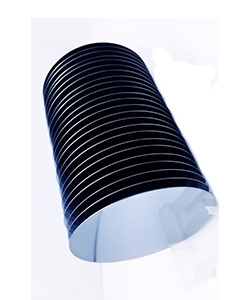
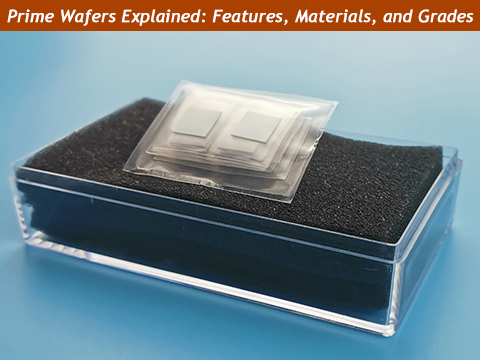
Prime wafers are the highest-quality semiconductor wafers used in commercial device manufacturing. They provide the surface quality, dimensional accuracy, and material consistency required for producing integrated circuits, power devices, sensors, LEDs, and other electronic components where performance and reliability are critical.A wafer is a thin, round substrate used to manufacture semiconductor devices. It acts as the base on which electronic circuits and components are built. Depending on the application, wafers can be made from materials such as silicon (Si), silicon carbide (SiC), sapphire, gallium arsenide (GaAs), and indium phosphide (InP). Before a wafer is ready for use, it goes through multiple manufacturing steps, including crystal growth, slicing, polishing, and quality inspection.
Since wafer quality directly affects device performance, manufacturing yield, and long-term reliability, wafers are available in different quality grades. Prime wafers represent the highest commercial grade and are typically used for semiconductor device production, where strict requirements for surface quality, defect control, and material consistency must be met.
In this guide, we will explain what prime wafers are, how they are manufactured, how they differ from other wafer grades, and the applications that rely on semiconductor-grade wafers.
What Is a Prime Wafer?
A prime wafer is a semiconductor wafer made to the highest industrial standards for manufacturing electronic devices. It is designed to meet strict requirements for purity, surface quality, and dimensional accuracy, ensuring reliable performance in demanding applications.Prime wafers differ from research-grade or dummy wafers, which are used mainly for experiments, prototyping, or equipment testing. Their consistent quality makes them essential for processes such as epitaxial layer growth, lithography, and device fabrication, where even small defects can affect yield and device performance.
The defining features of prime wafers include:
- Low defect density: Minimal crystal imperfections to support high-quality device production.
- Smooth, polished surfaces: Ensures accurate processing and uniform thin-film growth.
- Tight dimensional control: Consistent thickness, bow, and warp across the wafer.
- Uniform material properties: Reliable electrical and thermal characteristics across the entire wafer.
Prime wafers are available in several materials, including silicon (Si), silicon carbide (SiC), sapphire, gallium arsenide (GaAs), and indium phosphide (InP), each suitable for different device types—from power electronics to LEDs and high-frequency components.
How Semiconductor Wafers Are Manufactured
The manufacturing of semiconductor wafers generally involves two key stages: substrate production and epitaxial processing.A substrate wafer is a polished wafer made from a single-crystal semiconductor material. It can be used directly for device fabrication or serve as the foundation for epitaxial growth. In many advanced semiconductor applications, the substrate provides the structural and electrical base for subsequent device layers.
Epitaxy is the process of growing a new crystalline layer on the surface of a substrate wafer. The epitaxial layer may be made from the same material as the substrate or a different semiconductor material, depending on the device requirements. This process allows manufacturers to achieve precise electrical properties and create structures that are difficult to obtain using the substrate alone.
Substrate Manufacturing Process
The production of a substrate wafer begins with high-purity semiconductor materials. Using silicon as an example, raw silicon is refined through multiple purification steps to produce electronic-grade polysilicon with extremely high purity. The material is then melted and grown into a single-crystal ingot.After crystal growth, the ingot is processed into wafers through several manufacturing steps:
- Slicing – The crystal ingot is cut into thin wafers with controlled thickness.
- Mechanical processing – The wafer edges are shaped and dimensions are refined.
- Chemical treatment – Surface contaminants and damage are removed.
- Polishing – The wafer surface is polished to achieve the flatness and smoothness required for semiconductor fabrication.
- Quality inspection – Critical parameters such as thickness, crystal orientation, flatness, and surface quality are verified.
Epitaxial Wafer Production
For applications that require enhanced electrical performance, an epitaxial layer can be grown on the substrate surface.The epitaxial process creates a highly controlled crystalline layer with specific electrical characteristics. By adjusting the material composition and doping profile of the epitaxial layer, manufacturers can optimize wafers for power devices, RF components, LEDs, sensors, and other advanced semiconductor applications.
As a result, semiconductor wafers are commonly supplied as either substrate wafers or epitaxial wafers, depending on the requirements of the final device.
Wafer Grades Explained
Not all semiconductor wafers are manufactured to the same quality standard. Depending on their intended use, wafers are generally classified into different grades. These grades help manufacturers, researchers, and engineers select the most appropriate wafer for production, development, or testing while balancing performance requirements and cost.The most common wafer categories are Prime Grade Wafers, Test or Research Wafers, and Dummy Wafers.
Prime Grade Wafers
Prime wafers represent the highest commercial quality available for semiconductor manufacturing. They are designed for device production where high yield, consistent performance, and long-term reliability are essential.Key characteristics of prime wafers include:
- Very low defect density
- Excellent surface quality and flatness
- Tight control of thickness, bow, and warp
- Consistent electrical and material properties
- Strict inspection and quality standards
Test and Research Wafers
Test wafers and research wafers are commonly used for process development, prototyping, academic research, and engineering evaluation. Depending on the supplier and material type, they may also be referred to as Research Wafers, R&D Wafers, Engineering Wafers, or Development Wafers.Compared with prime wafers, these wafers may allow a higher level of crystal defects, surface imperfections, or dimensional variation while still maintaining sufficient quality for experimental work.
Typical applications include:
- University and laboratory research
- Prototype device development
- Epitaxy process optimization
- Thin film deposition studies
- New material evaluation
- Process qualification and monitoring
Dummy Wafers
Dummy wafers are used primarily for equipment setup, process calibration, and manufacturing support activities. Unlike prime or research wafers, dummy wafers are not intended for functional device fabrication.Since their purpose is process verification rather than device production, surface quality and defect levels are generally less critical.
Common uses include:
- Equipment qualification
- Furnace conditioning and preheating
- CMP process development
- Etching and deposition trials
- Production line maintenance
- Operator training
Choosing the Appropriate Wafer Grade
The appropriate wafer grade depends on the intended application:- Prime Wafers → Commercial semiconductor manufacturing
- Test or Research Wafers → R&D, prototyping, and process development
- Dummy Wafers → Equipment testing, calibration, and process setup
Selecting the correct wafer grade helps optimize manufacturing costs while ensuring that quality and performance requirements are met throughout the development and production cycle.
Materials Used for Prime Wafers
Prime wafers can be manufactured from a variety of semiconductor materials, each offering unique electrical, thermal, and optical properties. The choice of wafer material depends on the requirements of the final device, including operating voltage, frequency, temperature, and performance targets.Silicon (Si) Wafers
Silicon remains the most widely used semiconductor material in the world. Its abundance, mature manufacturing technology, and excellent material stability have made it the foundation of the modern semiconductor industry.One of silicon's key advantages is its ability to form a high-quality silicon dioxide (SiO₂) insulating layer, which plays a critical role in integrated circuit fabrication. Today, more than 95% of semiconductor devices and over 99% of integrated circuits are manufactured on silicon substrates.
Prime silicon wafers are essential for logic devices, memory chips, microprocessors, and other consumer and industrial electronics.
Gallium Arsenide (GaAs) and Indium Phosphide (InP) Wafers
GaAs wafers and InP wafers are often referred to as second-generation semiconductor materials. Compared with silicon, they offer higher electron mobility and better high-frequency performance, making them suitable for applications that require fast signal transmission and efficient optical communication.Prime GaAs and InP wafers are widely used in:
- RF and microwave devices
- Optical communication systems
- Satellite communications
- GPS technologies
- Laser diodes and photonic devices
Silicon Carbide (SiC) and Gallium Nitride (GaN) Wafers
SiC wafers and GaN wafers are known as third-generation semiconductor materials or wide-bandgap semiconductors. These materials have become some of the fastest-growing semiconductor substrates due to their ability to operate under conditions that are difficult for conventional silicon devices.Compared with silicon, SiC and GaN offer:
- Higher electron mobility
- Superior high-frequency performance
- Higher power handling capability
- Better thermal conductivity
- Greater radiation resistance
- Higher breakdown voltage
As demand for energy-efficient and high-performance electronics continues to grow, prime SiC and GaN wafers are becoming increasingly important across a wide range of industries.
Sapphire Wafers
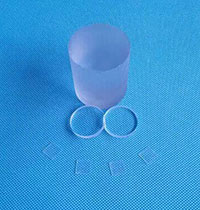
Sapphire wafers are primarily used in optoelectronics and LEDs. They provide mechanical hardness, chemical stability, and optical transparency, ensuring consistent performance in devices that rely on precise light emission or detection.Conclusion
Prime wafers are the foundation of modern semiconductor devices. They provide the purity, precision, and reliability needed to make advanced chips and electronic components used in computers, electric vehicles, renewable energy systems, and more.Unlike test or dummy wafers, prime wafers are made for real production, ensuring devices perform consistently and efficiently. Choosing the right material—whether silicon, SiC, GaN, GaAs, or sapphire—can make a big difference in device performance, durability, and manufacturing yield.
At AEM Deposition, we supply high-quality prime wafers in a wide range of materials and sizes, helping manufacturers and researchers bring their designs to life with confidence. Contact us today to discuss your project and find the perfect wafer solution for your application.
LATEST NEWS